E-Commerce Website Development Course in Gujranwala: Complete Guide
Author : Muhammad Waheed
E-Commerce Website Development Course in Gujranwala: Complete Guide
1. Introduction
Online shopping has changed the way customers discover products, compare options and place orders. For businesses, an e-commerce website can provide a digital sales channel that operates beyond the limitations of a physical shop.
This has created demand for people who understand how e-commerce websites are designed and developed. Students searching for an E-Commerce Website Development Course in Gujranwala can use this field as a pathway into web development, freelancing and digital business services.
However, an e-commerce website is more complicated than an ordinary informational website. It may need product catalogs, categories, search, customer accounts, carts, orders, checkout, inventory, payment integration, security, database management and administrative functionality.
2. What is E-Commerce Website Development?
E-commerce website development involves creating online systems through which businesses can display products or services and allow customers to interact with them.
A basic store may include product listings, product detail pages, categories, a shopping cart and checkout process. More advanced systems can include customer accounts, order tracking, inventory, coupons, payment gateways, shipping systems, reviews, reporting and administrative dashboards.
Developers therefore need both front-end and backend understanding.
3. Why Learn E-Commerce Development?
Businesses increasingly need digital sales channels. Local retailers, wholesalers, manufacturers, service businesses and startups can all potentially benefit from e-commerce.
For students, learning e-commerce development provides an opportunity to combine several technical skills. A project may require HTML and CSS for the interface, JavaScript for interaction, backend programming for business logic and a database for products and orders.
E-commerce development also provides useful project experience because it exposes students to realistic business requirements.
4. Benefits
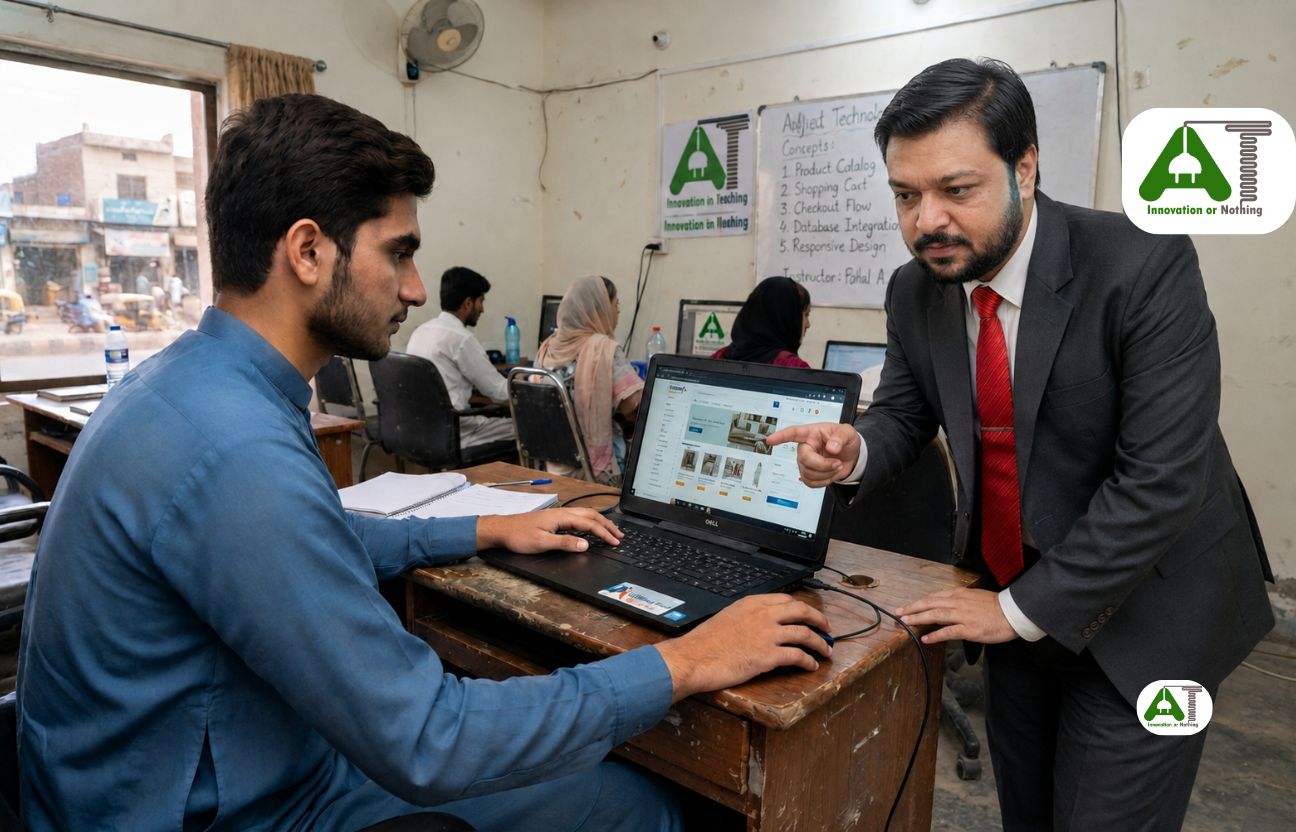
Practical Hands-On Training
Students should develop actual online-store functionality during training.
Industry-Focused Curriculum
The curriculum should cover the technical components commonly required in e-commerce systems.
Experienced Trainers
Trainer guidance helps students understand complex workflows such as carts, orders and databases.
Real Project Learning
A complete online-store project can become a strong portfolio piece.
Career Guidance
Students can explore employment, agency work, freelancing and entrepreneurial opportunities.
Gujranwala-Based Learning Advantage
Students can learn in a structured local environment and potentially understand the requirements of nearby businesses.
5. Skills Covered
- HTML
- CSS
- Responsive design
- JavaScript
- Product catalog development
- Category systems
- Product detail pages
- Shopping cart concepts
- Checkout workflows
- Customer accounts
- Database management
- Order management
- Authentication
- API concepts
- Payment integration concepts
- Security awareness
- Testing
- Deployment
6. Course Learning Roadmap
Stage 1: Web Fundamentals
Learn HTML, CSS, responsive design and basic JavaScript.
Stage 2: Database Fundamentals
Understand how products, customers and orders can be stored.
Stage 3: Product System
Create products, categories and product-detail functionality.
Stage 4: Shopping Cart
Implement cart behavior and understand how selected products are maintained.
Stage 5: Authentication
Build customer registration and login functionality.
Stage 6: Orders
Develop an order workflow that connects customers, products and order information.
Stage 7: Payment Integration
Learn the concepts involved in connecting secure payment services where appropriate.
Stage 8: Complete Project
Build and test a complete e-commerce project.
7. Career Opportunities
E-commerce development skills can support careers in web development agencies, software companies, online businesses and freelance development.
Students may work on store development, frontend interfaces, backend functionality, maintenance, integrations, bug fixing or e-commerce optimization.
Those interested in entrepreneurship can also use their technical skills to build online businesses, although running an e-commerce business requires much more than technical development.
8. Freelancing Opportunities
E-commerce development can provide freelance services such as online-store development, product-page implementation, shopping-cart functionality, website redesign, custom features, maintenance and third-party integrations.
Because e-commerce projects can directly affect a client's business, freelancers must take testing, security, backups and communication seriously.
A beginner should avoid accepting complicated payment or order-management projects without understanding the technical and security requirements.
9. Why Choose Abiding Tech Education
When choosing web development training in Gujranwala, students should evaluate whether the program includes practical hands-on training, an industry-focused curriculum, experienced trainers, real project learning and career guidance.
The Gujranwala-based learning advantage can also help students understand local business requirements and receive direct assistance during practical exercises.
Students can review the supplied Web Designing and Development course as one available web-development training option.
10. FAQs
Is e-commerce development difficult?
It is more complex than a basic informational website because it can involve products, users, carts, orders, databases and payments. A structured learning path makes the process easier.
Do I need programming for e-commerce development?
For custom e-commerce development, programming knowledge is highly valuable. The exact level depends on the technology and platform being used.
Can I freelance with e-commerce skills?
Yes. Freelancers can provide online-store development and maintenance services.
What should an e-commerce portfolio project contain?
A useful project can include product listings, categories, product details, cart functionality, customer accounts and an appropriate order workflow.
Are payment gateways difficult?
Payment integrations require careful implementation and security awareness. Students should learn the official integration process for whichever payment provider they use.
11. Conclusion with CTA
An E-Commerce Website Development Course in Gujranwala can provide students with practical experience across multiple areas of web development. Unlike a simple webpage, an online store introduces realistic requirements such as products, customers, carts, orders and databases.
The strongest training approach combines practical hands-on training, an industry-focused curriculum, experienced trainers, real project learning, career guidance and the advantages of a Gujranwala-based learning environment.
If you are building your web-development foundation, review the supplied Web Designing and Development course from Abiding Tech Education and compare the learning path with your e-commerce career goals.
People Reviews
Based on 0 reviews