Full Stack Web Development Course in Gujranwala | Career Guide

Author : Muhammad Waheed
Full Stack Web Development Course in Gujranwala: Complete Learning & Career Guide
1. Introduction
A modern website can look simple on the screen while relying on many technical systems behind it. The visible interface, business logic, database, authentication, APIs, server, and deployment process may all work together to deliver a single web application. Learning to work across these different layers is the foundation of full stack web development.
For students and aspiring developers in Gujranwala, a full stack web development course can provide a structured pathway into modern website and application development. Instead of focusing only on the visual side of a website, full stack learning introduces both front-end and back-end concepts.
However, students should understand that becoming a full stack developer is not achieved simply by memorizing several technologies. The real objective is to understand how different components communicate and to develop the ability to build complete, functional projects.
2. What is Full Stack Web Development?
Full stack web development refers to development work that covers multiple layers of a web application. The front end is the part users interact with in a browser. The back end handles application logic, data processing, authentication, APIs, and communication with databases and other services.
A typical full stack learning path may include HTML, CSS, JavaScript, a front-end framework or library, server-side programming, databases, APIs, authentication, deployment, debugging, and version control.
The exact technologies depend on the curriculum. Students should therefore ask an institute which technologies are actually taught instead of assuming that a course title automatically means every modern framework is included.
3. Why Learn Full Stack Web Development?
One of the biggest advantages of full stack learning is broader technical understanding. A developer who understands only the front end may depend heavily on another developer for back-end functionality. Someone with full stack knowledge can understand how the complete system fits together.
This does not mean every developer must become an expert in every technology. In fact, trying to master too many technologies simultaneously can slow down beginners. The better approach is to build strong fundamentals and gradually specialize.
Full stack skills can also be useful for freelancers and entrepreneurs because a developer can understand the requirements of complete web projects and communicate more effectively with clients.
4. Benefits
Complete Development Understanding
Students learn how the user interface, application logic, database, and server-side systems interact.
Real Project Learning
Full stack concepts become much easier to understand when students build complete applications rather than isolated coding exercises.
Practical Hands-On Training
Students should spend substantial time writing code, debugging applications, connecting components, and testing functionality.
Industry-Focused Curriculum
A strong curriculum should emphasize transferable development concepts rather than simply following short-lived technology trends.
Career Flexibility
Full stack knowledge can support different career directions, including junior development, front-end specialization, back-end specialization, freelance development, and startup projects.
Gujranwala-Based Learning Advantage
Local classroom training can give beginners direct access to trainers, classmates, practical exercises, and a consistent learning schedule.
5. Skills Covered
- HTML and semantic webpage structure
- CSS and responsive layouts
- JavaScript fundamentals
- Programming logic
- Front-end development concepts
- Back-end development concepts
- Database fundamentals
- APIs and data communication
- Authentication concepts
- CRUD operations
- Debugging and testing
- Version control concepts
- Deployment fundamentals
- Real project development
Students should confirm the exact technology stack before admission because “full stack” is a broad term and different institutes may define it differently.
6. Course Learning Roadmap
Foundation
The first stage should establish understanding of websites, browsers, files, development environments, and basic programming logic.
Front End
Students learn HTML, CSS, responsive design, and JavaScript. The objective is to create interfaces that are structured, attractive, functional, and usable on different screen sizes.
Programming
Students develop stronger programming logic through variables, conditions, loops, functions, arrays, objects, and problem-solving exercises.
Back End
The next stage introduces server-side programming, routing, data processing, authentication, and application logic.
Database
Students learn how information is stored, retrieved, updated, and deleted. Database concepts are essential for applications involving users, products, orders, bookings, or other persistent data.
APIs
Modern applications frequently communicate through APIs. Understanding requests, responses, authentication, data formats, and error handling is therefore an important development skill.
Project
The learning process should culminate in real project development. A project forces students to connect the concepts they learned separately.
7. Career Opportunities
A full stack learning path can support several technology careers. Depending on experience and specialization, students may eventually pursue roles such as junior web developer, full stack developer, front-end developer, back-end developer, web application developer, or software development roles.
Students should be realistic about entry-level expectations. Completing training is only the beginning. Employers typically look for evidence that candidates can solve problems and build working software.
A portfolio is therefore extremely important. It should contain projects that demonstrate actual ability rather than copied templates with no explanation of the student's contribution.
8. Freelancing Opportunities
Full stack development can be particularly useful for freelancing because clients frequently want complete solutions rather than isolated pieces of code.
A freelancer may eventually offer services such as business websites, custom dashboards, web applications, API development, database-backed systems, website maintenance, bug fixing, or feature development.
However, beginners should avoid offering every possible service. A focused service is easier to market. For example, a beginner could specialize in business websites or small web applications before moving into more complex projects.
Freelancing also requires client communication, requirements analysis, estimation, documentation, testing, and after-delivery support. These skills should be developed alongside technical knowledge.
9. Why Choose Abiding Tech Education
Students in Gujranwala should compare institutes based on actual learning quality rather than advertisements. Important factors include practical hands-on training, an industry-focused curriculum, experienced trainers, real project learning, and career guidance.
A Gujranwala-based classroom environment can be useful for beginners who want direct trainer interaction and a structured learning routine.
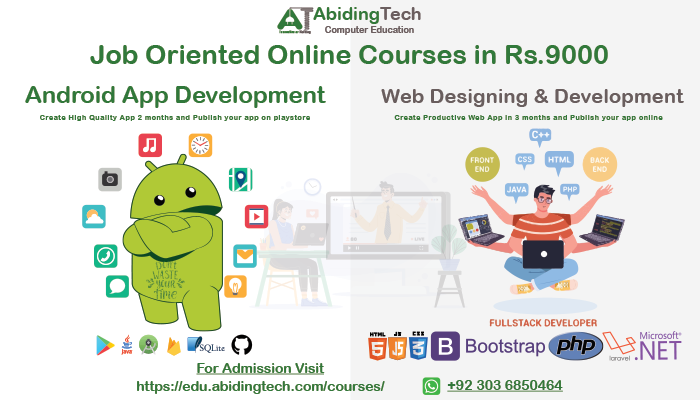
Students who want to investigate the available web training can review the Web Designing and Development course offered by Abiding Tech Education.
10. FAQs
What does a full stack developer do?
A full stack developer works across different parts of a web application, potentially including the front end, back end, database, APIs, authentication, and deployment.
Is full stack development suitable for beginners?
Yes, but beginners should learn progressively. Trying to learn multiple frameworks before understanding HTML, CSS, JavaScript, and programming fundamentals can create unnecessary confusion.
How long does it take to learn full stack development?
The timeline depends on the student's background, study hours, curriculum, and practice. Course duration and professional competence are not the same thing. Students need continued practice after formal training.
Can I become a full stack developer without a degree?
It is possible to enter web development without a computer science degree, but strong practical skills, projects, problem-solving ability, and continued learning are essential.
Is full stack development good for freelancing?
Yes. Full stack knowledge can help freelancers understand and deliver broader web projects. However, freelancing success depends on both technical and business skills.
What is the most important skill for a beginner?
Problem-solving is more important than memorizing syntax. A developer must be able to understand a requirement, break it into smaller problems, test possible solutions, and debug mistakes.
11. Conclusion with CTA
A Full Stack Web Development Course in Gujranwala can be a useful starting point for students who want to understand complete web applications rather than only webpage design. The strongest learning path combines fundamentals, practical hands-on training, industry-focused concepts, real project learning, experienced trainers, and career guidance.
Do not select a course simply because it uses the words “full stack.” Check the actual syllabus, training method, projects, duration, and support provided to students.
If you are exploring web development training in Gujranwala, review the Web Designing and Development course at Abiding Tech Education and compare its content with your learning and career goals.
People Reviews
Based on 0 reviews